
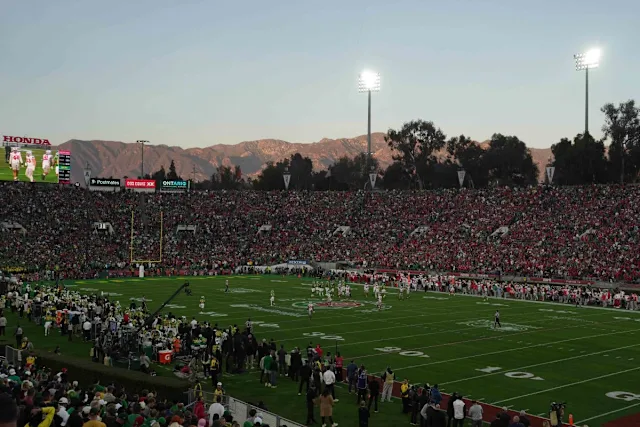

PASADENA, Calif. — The first year of the expanded 12-team College Football Playoff faced a visible hurdle on New Year’s Day as the quarterfinal matchup between the No. 2 Oregon Ducks and No. 7 Georgia Bulldogs saw a startling number of empty seats at the historic Rose Bowl. Images from the broadcast and social media quickly circulated, describing the turnout as “embarrassing” for a game of such high stakes.
While the Rose Bowl traditionally serves as a sell-out destination for the “Granddaddy of Them All,” the transition to a playoff quarterfinal site appeared to impact ticket demand. Official attendance figures were notably lower than the stadium’s 92,542-person capacity, with significant gaps visible in both the upper end zones and the corner sections during kickoff.
Industry analysts suggest that the lower attendance is a direct byproduct of the new playoff structure. Under the 12-team format, fans of top programs like Georgia and Oregon are being asked to potentially fund travel for three to four different postseason games. Georgia fans, in particular, had just traveled to Atlanta for the SEC Championship and many were reportedly opting to save resources for a potential semifinal or National Championship appearance.
“We’re asking a lot of the families and the fans,” noted one bowl executive prior to the game. “When you move from a one-game championship model to a multi-week bracket, the travel costs become a major barrier, especially during the holiday season.”
The secondary ticket market reflected the lack of demand. Hours before the game, tickets on major exchange platforms were reportedly listed for as low as $40, a fraction of the typical Rose Bowl asking price. This stands in stark contrast to the inaugural 12-team first-round games played on campus sites, which saw record-breaking sell-outs at venues like Ohio State and Penn State.
Despite the atmosphere in the stands, the action on the field remained competitive. However, the visual of a half-empty Rose Bowl has sparked an immediate debate among NCAA leadership regarding the long-term viability of using neutral-site bowls for the quarterfinal round. Critics argue that the quarterfinals should follow the lead of the first round and be held at the home stadium of the higher seed to ensure capacity crowds and “true” collegiate atmospheres.
As the College Football Playoff committee prepares for the 2026-2027 cycle, the “embarrassing” optics in Pasadena will likely serve as a primary data point in discussions regarding future site selections and the logistical burden placed on loyal fanbases.